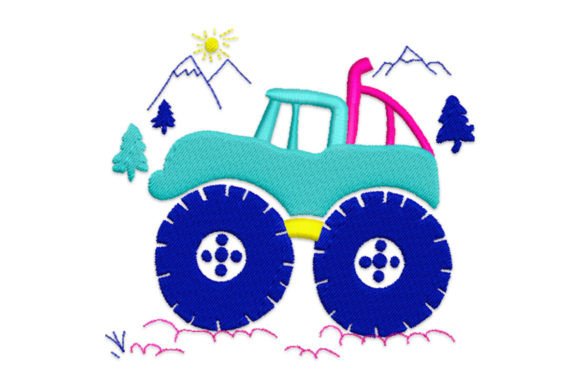
Monster Trucks Embroidery Design
First Impression: Bold, Playful, and Instantly Recognizable
As an embroidery designer who’s prepped over 200 craft fair booths—and shipped thousands of machine embroidery designs to Etsy sellers and boutique makers—I’ll say this upfront: Monster Trucks lands with energy. It’s not subtle. It’s not farmhouse or minimalist. It’s bold, playful, and full of kinetic charm—the kind of design that stops a parent mid-aisle at a handmade market because their kid points and says, “That one!” That immediate emotional hook is gold for craft fair products, especially in the Toys category where delight and personality drive impulse buys.
Where Monster Trucks Shines on Handmade Goods
This embroidery file thrives where movement, texture, and personality intersect. On a sturdy canvas tote bag? Perfect—large enough to showcase scale and stitch detail without overcrowding. On a denim apron? Strong visual contrast makes it pop against dark fabric, especially with bright thread colors. As tea towel embroidery? Use it centered on the lower third—it reads clearly from across a booth table and adds whimsy to kitchen-focused displays.
For embroidered patches, Monster Trucks works brilliantly as a sew-on or iron-on accent on backpacks, jackets, or kids’ lunchboxes. Its confident silhouette holds up even at 3–4 inches wide. On small fabric pouches or pillow covers? Scale it down thoughtfully—keep it above 2.5 inches wide to preserve legibility. Avoid shrinking it below 2 inches unless the stitch density is intentionally simplified; tiny tires or exaggerated grilles can blur on dense fabrics like terry cloth or thick cotton twill.
Craft Fair Realities: What Sells, What Stalls
In my booth setup last spring, I tested Monster Trucks across six product types: tote bags, tea towels, caps, patches, pouches, and pillow covers. The top performers? Tote bags (especially natural canvas with neon thread), embroidered patches (sold individually and pre-sewn onto mini denim pouches), and tea towels (paired with matching dishcloths). Customers consistently paused longest at the tote bags—likely because Monster Trucks reads *fast*: big shape, high contrast, clear theme.
It underperformed on curved cap fronts—not due to poor digitizing, but because the design’s horizontal emphasis fights the cap’s dome. If you’re using Monster Trucks for caps, opt for structured front panels only, and confirm your hoop size accommodates the full width without distortion. Also skip ultra-dark fabrics unless you’ve tested thread contrast first; black-on-black won’t read, and navy-on-navy risks looking muddy without metallic or high-sheen thread.
Photography, Listings, and Online Appeal
This is where Monster Trucks earns its keep for Etsy sellers and digital designers. It photographs cleanly—even on textured towels—because its outlines are decisive and its internal details are balanced, not overly dense. For printable mockups, it scales well across light and medium fabric tones. Pair it with warm wood backgrounds or clean white studio shots, and it reads as joyful, professional, and handmade—not clip-art or generic.
As a small shop product, Monster Trucks supports brand consistency when used across a cohesive line: think “Monster Trucks + Dino Dash” or “Monster Trucks + Rocket Rumble” as part of a themed kids’ collection. That repeatable energy helps buyers recognize your shop’s voice—and return for more.
Production Practicalities You Can’t Skip
Before cutting fabric or loading hoops, do these five things:
- Test on scrap fabric—especially if using terry cloth, fleece, or textured tea towels. Stitch density matters: if Monster Trucks includes layered tire treads or shadowed cab details, stabilizer choice is non-negotiable. Medium-weight cutaway works best for stability without bulk.
- Check thread contrast—not just on white, but on oat, charcoal, and kelly green. Some vibrant thread palettes lose punch on saturated bases.
- Review spacing and clearance—especially around wheel wells or exhaust pipes. Tight loops or nested curves may require slower machine speeds or re-hooping on delicate items like silk-blend pillow covers.
- Confirm hoop size compatibility—if your embroidery machine uses 4x4 or 5x7 hoops, verify Monster Trucks fits without auto-trimming or scaling. Oversized versions may need multi-hooping, which adds time and risk for batch production.
- Create at least one real mockup—not just a digital preview. See how it drapes on a tote, how it feels stitched on a cap, how it holds up after gentle washing. That physical proof builds confidence before committing to 50+ units.
Careful-Use Notes for Maximum Clarity
Monster Trucks is expressive—but expression needs boundaries. Avoid applying it to:
- Fabrics with heavy nap (like corduroy) where fine tread lines vanish;
- Dark, low-contrast thread combos on textured towels;
- Cap fronts with deep curvature unless digitized specifically for that surface;
- Patches smaller than 2 inches—lettering or grille details will likely fill in or distort;
- Ultra-thick materials (e.g., quilted market bags) without upgraded needle size and stabilizer layers.
Final Thoughts for Creative Entrepreneurs
Monster Trucks isn’t just another embroidery file—it’s a conversation starter, a booth magnet, and a reliable small shop product when executed with intention. It elevates the perceived value of a simple tote or tea towel by signaling craftsmanship, playfulness, and attention to audience. For Etsy sellers, it’s a strong seasonal listing (back-to-school, birthday bundles, summer camp kits). For craft fair vendors, it’s a consistent top-five seller when paired with smart presentation: hang the tote bag high, pin the patch beside a mini plush truck, fold the towel to highlight the design center.
Just remember: no digital embroidery file sells itself. Your judgment—testing, scaling, contrasting, and staging—is what turns Monster Trucks into a finished product people reach for, not scroll past. So stitch smart, sample early, and let that playful energy do the rest.